Why healthcare leaders should invest in AI and robotics for operations
Implementing robotics & AI in unexpected places
Every day, people at leading institutions are implementing AI and robotics, all with the same goal: providing high-quality care, at scale, while managing costs. Surgical robots are ubiquitous now, as is artificial intelligence technology in fields such as diagnostics and radiology.
Cleveland Clinic believes that, to truly build the hospital of the future, we also have to look deeper and use new technology in places the patient may never see.
There is a tremendous opportunity in healthcare to optimize the inner workings of our systems: improving how goods get from place to place, fostering better communication between care teams and other members of hospital staff, and monitoring the massive amount of inventory that supports every surgery and clinical visit.
We have created meaningful change by improving processes that often get the least exposure. That is why, in 2025, Cleveland Clinic is expanding its robotics delivery programs to include automated aerial drones made by Zipline. It is one of many ways Cleveland Clinic is embracing AI and robotics to make healthcare more efficient.
The following paper includes three examples of AI and robotics programs Cleveland Clinic has implemented.
To truly build the hospital of the future, we have to look deeper and use technology in places the patient may never see.
Automating the delivery of supplies with robots
By automating the delivery of supplies, hospitals and health systems save time for workers and improve reliability.
Since 2008, a fleet of 81 autonomous vehicles has transported food, carried supplies, and supported janitorial staff at the health system’s main campus in Cleveland. These robots transport goods roughly a half mile from the service center to locations across campus. Completing more than 2,500 trips every day, delivery robots have become an integral part of daily life for Cleveland Clinic staff.
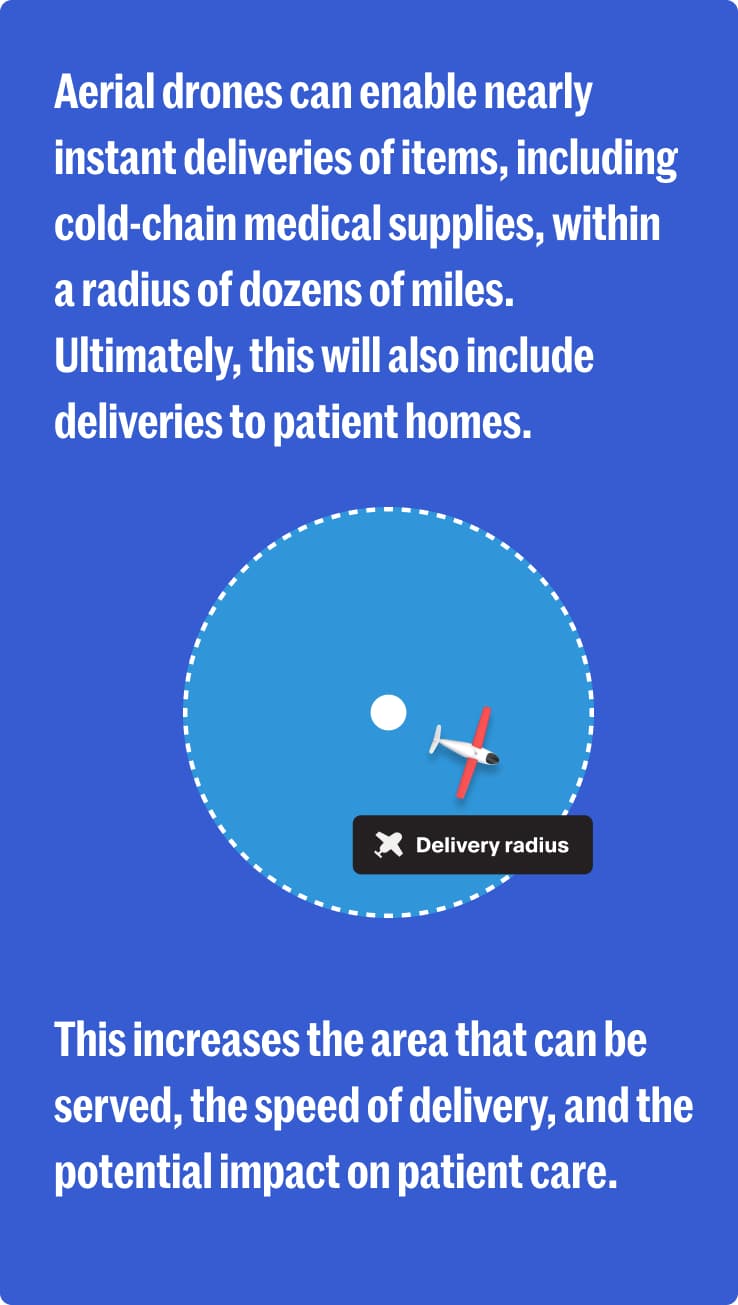
To take automated delivery to the next level, Cleveland Clinic is working with Zipline to explore how drones can supplement the courier system within the hospital, between hospitals, and finally, to patients at home.
Zipline’s delivery system will extend Cleveland Clinic’s ability to support quality care with advanced robotics. Unlike traditional delivery services, drones can bring medication and other supplies to their destination within minutes. Every delivery is also fully trackable, so staff can make sure they get what they need when they need it.
Streamlining staff requests for supplies
In 2023, Cleveland Clinic rolled out an AI-powered chatbot that answers supply orders from hospital staff. Designed for nurse managers and administrators who place monthly orders, the goal is to create a direct line of communication between staff and the supply chain team.
Early feedback has been positive, and early adopters have suggested ways to improve it further. For example, staff members want the option to track exactly when orders arrive, to give feedback about substitute products, and to notify the supply chain team about issues with product availability. Cleveland Clinic is working on addressing these needs in Phase II of the chatbot project.
A foundation of staff support is critical to the success of the chatbot as Cleveland Clinic builds it for scale. The tool is not only designed to make life easier for staff—fast-tracking supply chain issues through AI—but also to help caregivers focus on patient care by minimizing the time they spend in the system.
Another way Cleveland Clinic supports staff members is by minimizing the time between when they request inventory and when it is available. Like the chatbot, instant, autonomous delivery will help solve this problem. Rather than overstocking expensive items in case clinicians need them, staff can order supplies they need and receive them within minutes.
Drone delivery will also reduce the need for health system leaders to book available drivers for courier services.
Tracking every high-value item in the hospital
Radio frequency identification, or RFID-tagging, has long been used to track supplies in hospitals. Paired with AI-enabled predictive analytics, RFID-tagging can improve hospital supply chain processes—and even prevent issues from occurring at all.
At Cleveland Clinic, we’ve RFID-tagged all implants and valuable items within the system. To make this knowledge actionable, we plug supply chain data into AI-enabled predictive analytics programs that compare the current state with past trends.
With this technology, we can flag products’ expiration dates, making sure we never use expired supplies in patient care. Should there ever be a recall, we can quickly track down products and remove them from shelves.
Tracking technology enables us to be proactive, heading off supply chain issues before they occur. For example, we can identify a potential product shortage and diversify our supply chain before an incident that might limit availability. We can compare the demand for a specific product with its country of origin, how critical we believe the product to be for care, and any risks associated with the supplier. This gives us the information necessary to make strategic decisions, such as keeping an extra week’s worth of inventory, or supplementing supply.
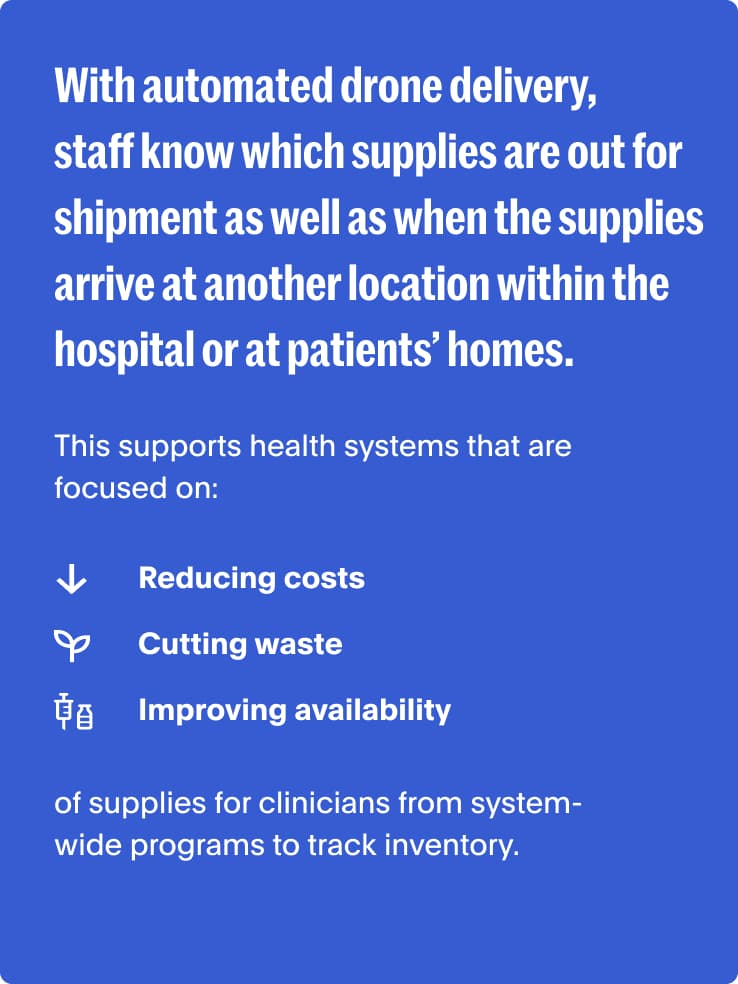
We can also make informed decisions about how we move supplies within the Cleveland Clinic network. When we have an oversupply at one location and an urgent need at another, we can quickly triage our internal supply chain.
In the future, we plan to use the drone delivery app to track not only our high-value items, but potentially any item transported by drones within or outside of the hospital. Technologies like Zipline delivery make it possible to know the location of millions of items in the supply chain.
We’re also figuring out ways to share more information about our inventory with our suppliers. By knowing the exact location of items in the hospital, and opening that information up to our suppliers, we can be extremely flexible—managing inventory before a shortage would affect patient care.
Conclusion
Making smart investments in AI and robotics for healthcare requires being open-minded about implementing new technology for processes that are less visible to patients—the day-to-day operations that keep the health system working smoothly. We’re investing in the behind-the-scenes areas of our system because we want our providers to have the tools and resources they need to provide the best possible care.
We’ve listed three examples borne out of that approach and discussed our system-wide goal of building an inherently flexible supply chain designed not only to adapt to—but also benefit from—the fast rate of change that has become normal in healthcare. We hope that the success we’ve seen at Cleveland Clinic with this approach can benefit health systems everywhere.
More about Cleveland Clinic
Cleveland Clinic is a global healthcare provider, recognized for providing world-class care. With 23 hospitals and 276 outpatient facilities in countries across the world, Cleveland Clinic’s more than 80,000 providers treat 3.3 million patients per year.
Cleveland Clinic has been recognized by Newsweek as the “World’s Best Smart Hospital” in 2025 and the #2 “Best Hospital” in 2024. For its 2024-2025 list, U.S. News & World Report named Cleveland Clinic the top heart hospital, an award it has won for 30 years. In 2024, Gartner named the health system among the “Top 25 Healthcare Supply Chains.”
More about Zipline
Zipline is the world’s largest logistics system, whose mission is to be the first to serve all humans equally. The company launched in 2016, delivering blood to treat patients in critical condition in hospitals in Rwanda. Since then, Zipline’s global network of drones has flown more than 90 million commercial autonomous miles across four continents. Today, Zipline makes a delivery about every 60 seconds.
The majority of Zipline deliveries, to-date, have been medical supplies, including temperature-sensitive products, prescription medication, over-the-counter medicines, ultra-cold-chain vaccines, plasma, platelets, and other supplies both to clinical facilities and patients’ homes.