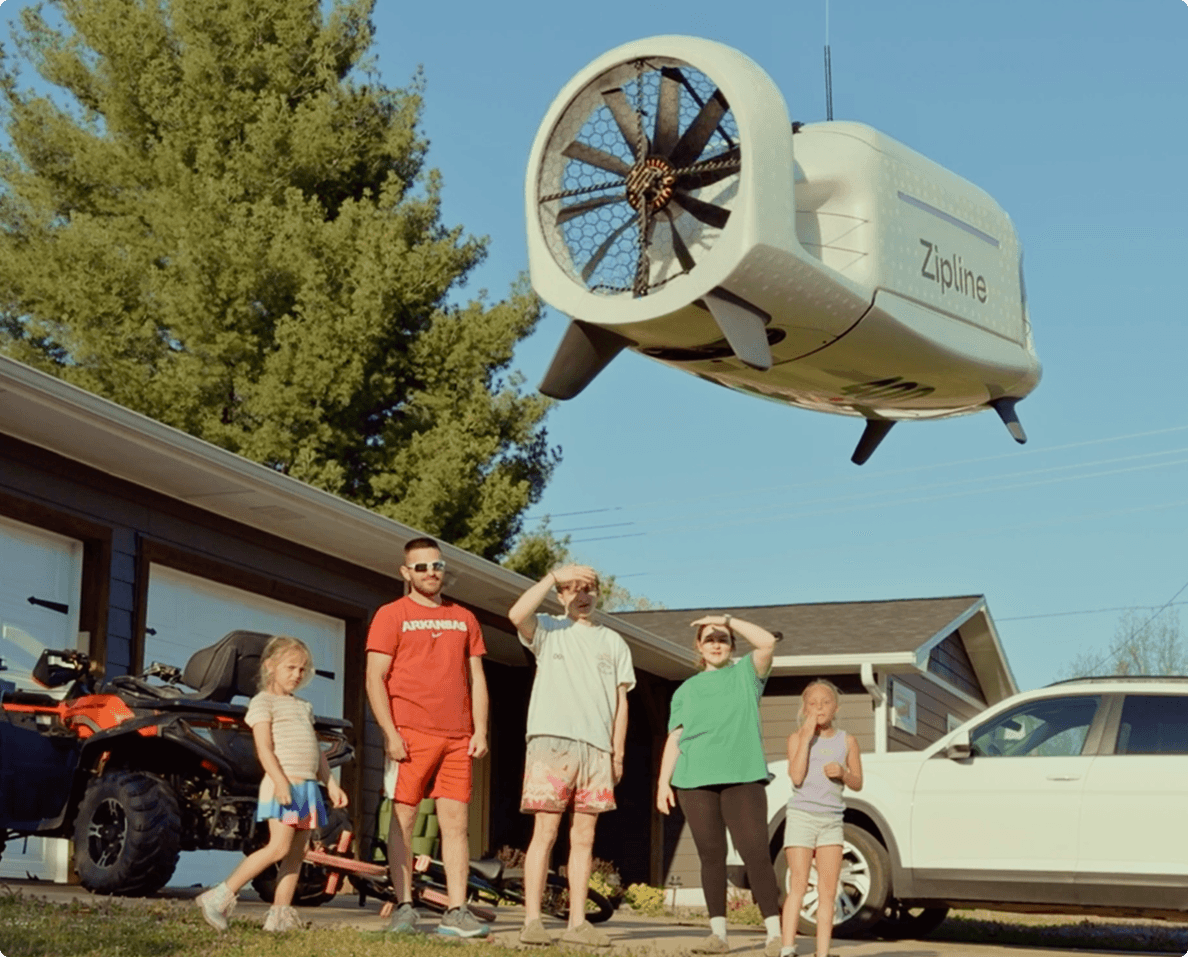
Zipline’s Never-Ending Quest to Make Quiet Deliveries Even Quieter
Zipline has now completed more than 2 million commercial deliveries – more than any other company in the drone delivery sector. Not only were all of our deliveries completed safely, Zipline deliveries have also been getting steadily quieter.
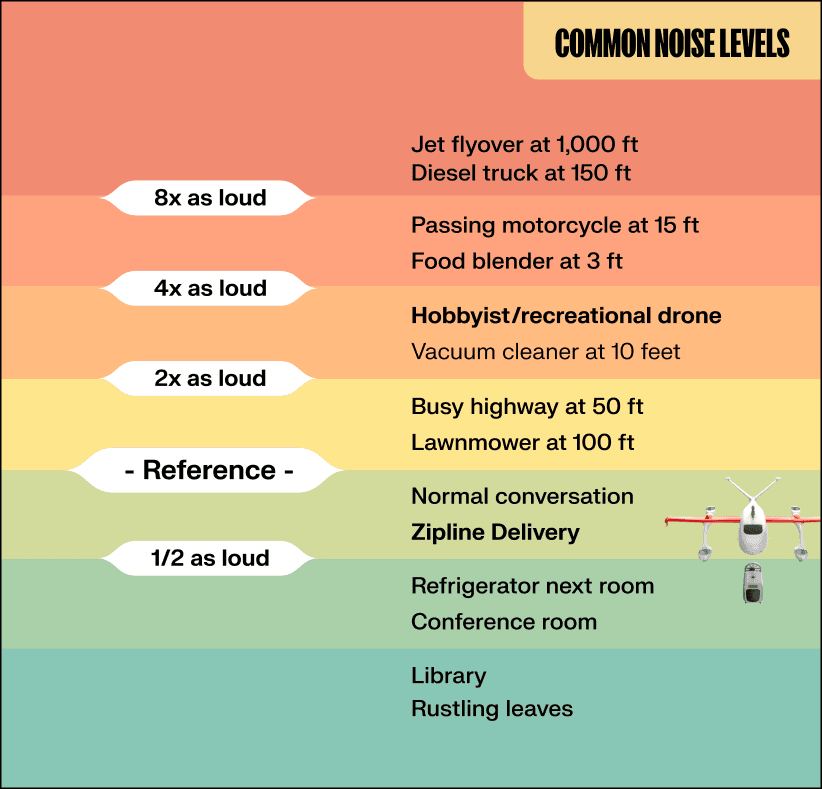
Our engineers scrutinize every millimeter, gram, and decibel of our operations for a simple reason: We believe that in order for the commercial drone delivery industry to become an integral part of last mile logistics, commercial drones need to blend safely and quietly into the background of everyday life. This principle has guided every decision we’ve made about our autonomous aircraft and our operations, and it’s why Zipline is 6 times quieter during delivery than others in the industry.
Below, we will walk through the intentional design behind our autonomous drone delivery system, what we’ve learned by operating in real-world conditions, and what’s on our roadmap to reduce noise even further.
Designing for Quiet Flights and Deliveries
First, we start with the design. Zipline’s two-part delivery architecture is a deliberate choice that reflects how serious we are about blending into communities. It’s also one of the most important ways to distinguish our aircraft from common recreational or hobbyist drones, which are smaller, fly close to the ground, and typically carry a noise level between 70-90 dB(A).
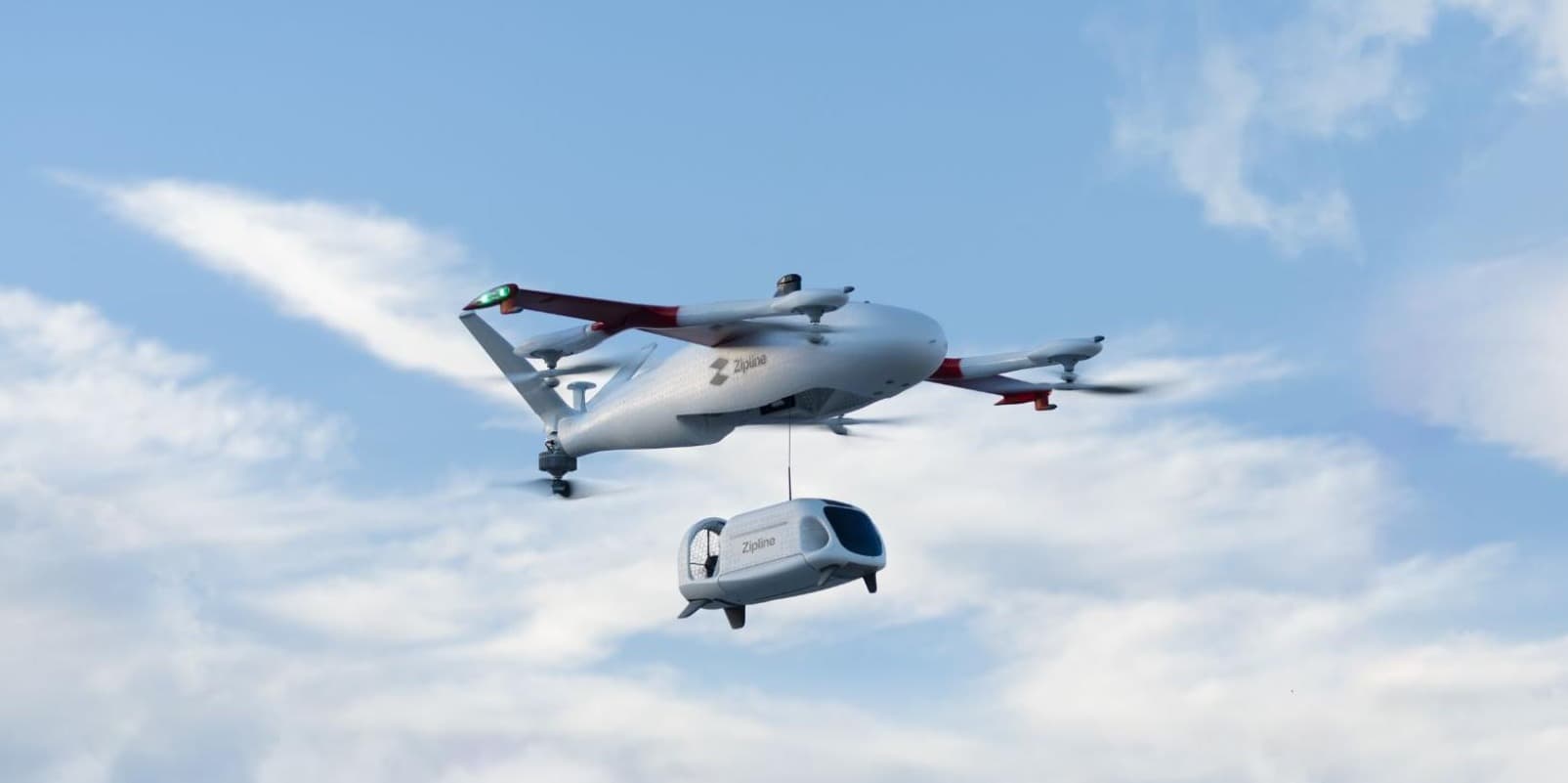
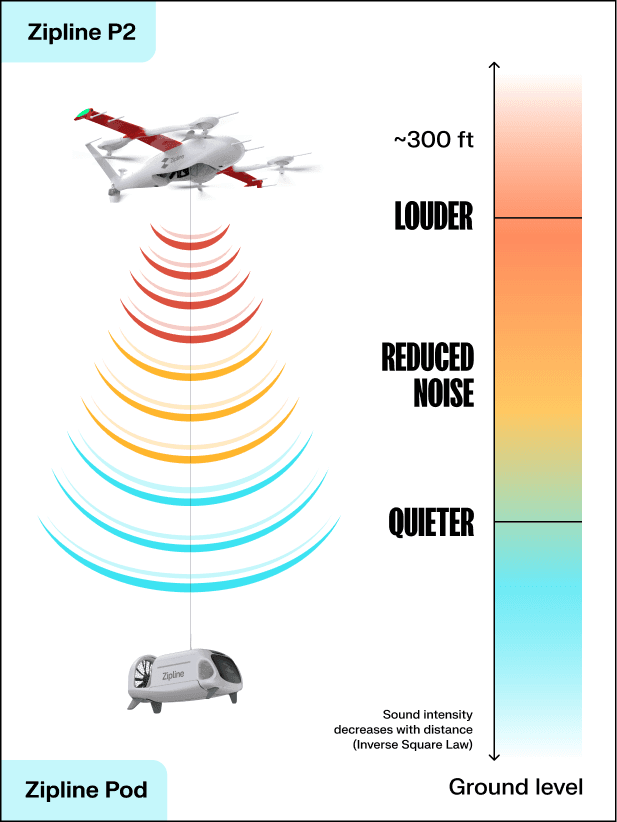
With a two-part design, our aircraft remain high in the sky during both transit and delivery. We recently raised our typical flying altitude to at least 300 feet—the length of a football field—a distance that helps sound energy dissipate significantly before reaching people below. When the aircraft is hovering for a delivery it remains high and releases a pod that carries the delivery package gently and safely to the ground. The entire delivery sequence takes about 90 seconds, dramatically limiting both duration and intensity of perceived noise. What’s more, we have plans to fly even higher in the future– up to 400 feet. That will mean even greater sound dissipation and a quieter experience for people on the ground.
Second, while Zipline aircraft take off and land vertically using their five propellers, we are working to ensure that more and more of the flight is spent in efficient fixed-wing forward flight. During forward flight, the wings generate lift aerodynamically, reducing the need for continuous high-power propulsion and thereby reducing decibels. These design choices allow the aircraft to significantly lower its total acoustic output. Fewer propellers operating more efficiently means less noise—especially in the frequency ranges the human ear is most sensitive to.
Why Zipline’s aircraft don’t sound like traditional drones
Perceived sound is not just about how many propellers are moving, but also how they are moving. When most people see the word drone, they think of the high-pitched, whiny buzz of a recreational quadcopter. That sound is caused by multiple small propellers spinning at very high rotational speeds, producing strong tonal peaks at high frequencies. And that’s exactly the opposite of how our aircraft are designed and developed.
Zipline propellers are designed to spin more slowly, shifting acoustic energy into lower frequencies that attenuate more naturally with distance. We also use uneven blade spacing, which breaks up harmonic reinforcement and reduces distinct tonal peaks. Instead of a sharp, easily identifiable pitch, the sound energy is spread across a broader frequency spectrum.
Over the years, we’ve gotten better and better at this.
The result is closer to what people perceive as a fan, rather than a discrete tone like an alarm. There isn’t a single “note” your ear can lock onto, which makes the sound significantly less intrusive. Consider the “hum” of vehicle traffic at a distance – it can also blend into the background as a continuous, low-variation sound. But when a delivery truck rumbles by your home or a motorcycle engine revs, it’s probably more noticeable than vehicle traffic or an airplane overhead.
How Zipline improves noise perception through its software
Aircraft acoustics aren’t solely determined by hardware, such as propellers. The software that allows our aircraft to fly autonomously also allows each aircraft to make better decisions about how to operate– and that plays a critical role in how noise is generated and perceived. For instance, our engineers can tune acoustic parameters that influence how thrust is allocated across propulsion systems. This gives the aircraft more intelligent options to reduce noise without restricting its ability to respond to unexpected conditions.
The challenge of the short “bursts”
Recently our engineers have been tackling a tough acoustics issue– the few seconds of short sound bursts that can occur during the aircraft’s acceleration into forward flight or in its deceleration before a hover. This happens when the aircraft is in mixed propulsion modes: it isn’t fully in hover or fully in forward flight – it’s in between – and that transition is acoustically expensive. If you listened carefully you could hear that noise would peak during the aircraft’s initial acceleration phase as motors got up to speed.
To mitigate this, Zipline engineers recently rolled out a software update that resulted in a 30% reduction in perceived noise by minimizing the aircraft’s time in mixed propulsion modes and smoothing out peaks. By coordinating tilt motion with aircraft pitch, the aircraft can opt to accelerate by leaning more on our acoustically-optimized hover propellers to carry most of the load forward. This action reduces transient acoustic spikes that are often more noticeable than steady-state sound.
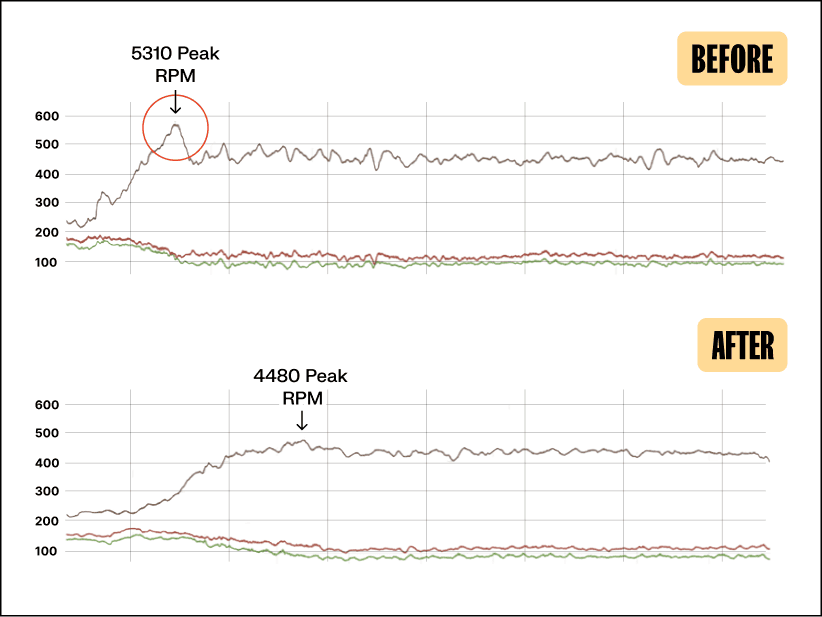
We also improved our acceleration profiles more broadly. As speed increases, aerodynamic drag rises sharply and requires more power—creating more noise. Fast acceleration creates even more noise, just like revving a car. We optimized how aggressively the aircraft accelerates and reduced its overall workload and acoustic output by considering all parts of a flight at a more granular level. In short, we programmed the aircraft to work smarter, not harder.
New environments, new lessons learned
Noise mitigation doesn’t stop with the aircraft itself. As we operate in new environments and gain real-world operating insights, we are able to get better insights into how sound travels from neighborhood to neighborhood.
By understanding these variables, our engineers are working to make sure our autonomous systems can make smarter routing and operational decisions on their own.
Our next phase of sound reduction means our aircraft will be smarter about finding ways to spread out their flight routes, avoiding “high-traffic” areas. We are also working to ensure our autonomous aircraft are equipped to make route modifications that avoid areas identified as noise-sensitive without compromising safety. These refinements will facilitate seamless integration with existing ambient soundscapes, allowing them to merge with, rather than distinctly interrupt, background noise. In a specific location, even small lateral shifts can make a big difference acoustically on the ground. That’s why we work closely with community members to hear their feedback. That information helps us continuously work on solutions to improve our operations.
What’s next
Our team of aeroacoustic engineers are continuing to push the envelope of performance, and have been hard at work making our next-generation of P2 aircraft the quietest yet. The team takes lessons from all of our flights to find the places where we can still improve, with even quieter cutting-edge propellers, smarter routing software, and smoother flights. In much of our current service area, Zipline blends into the background quite well but we know we have more work to do to be near-silent, which is our ultimate goal.
Quiet by default, better every day
We’ve made acoustics a priority at Zipline and we are excited for the big improvements on the horizon. But our work to keep dropping decibels is far from over. We are committed to ensuring drone deliveries blend into neighborhood sound profiles. Every delivery informs the next, and every improvement compounds across the system. From launch to cruise, hover to delivery, our goal is for Zipline aircraft to be barely noticeable—while becoming increasingly essential to everyday logistics and instant delivery.
More than two million deliveries in, we’re just getting started.