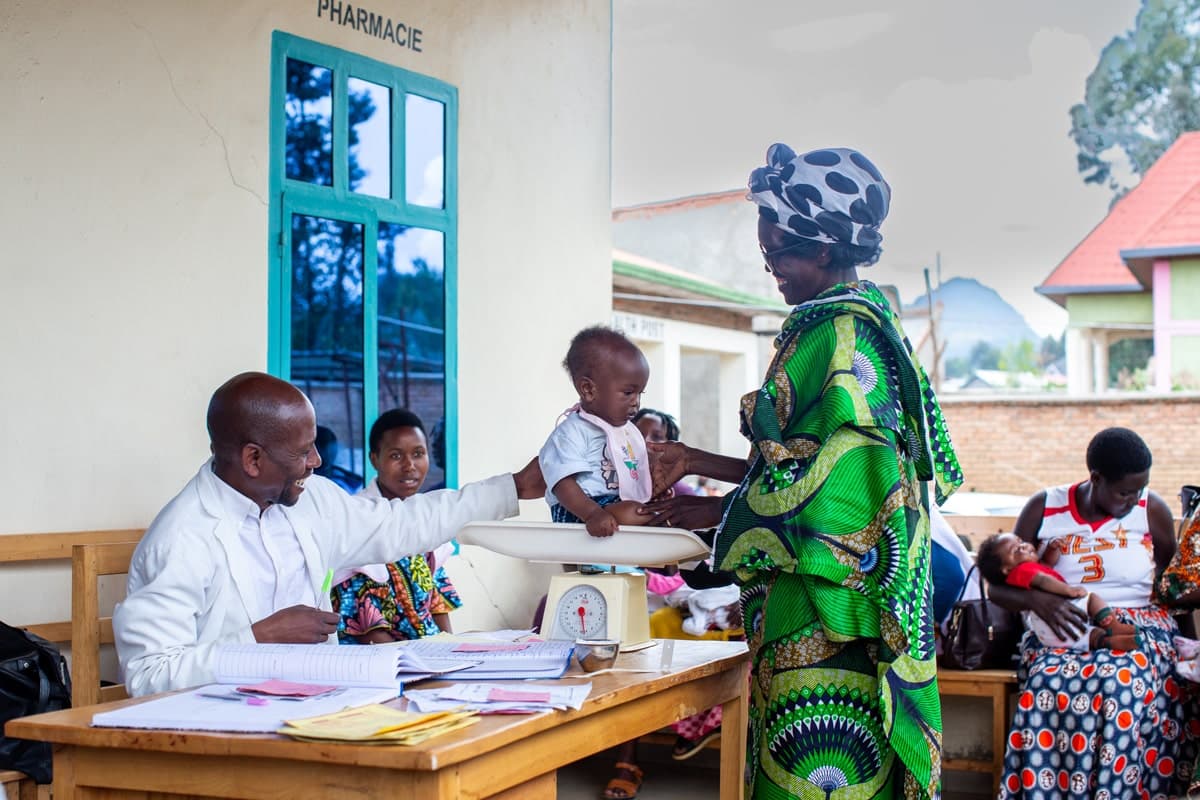
Bringing vaccines closer to home: A partnership to expand access in Rwanda
Rwanda is home to more than 14,000 villages, and until just a couple of years ago, access to healthcare for these communities often required hours-long journeys on foot or by unreliable roads.
While grappling with the COVID-19 pandemic in 2022, the Rwandan government began bringing healthcare closer to citizens by expanding a tier of facilities known as health posts. Previously, a few hundred of these community-level outposts offered essential services in the most remote areas of the country. Now 1,200 of these facilities, which maintain basic staff and supplies for the prevention and treatment of minor diseases, also offer critical services such as maternal and child healthcare, eye exams, prescription medications and dental care.
But until recently, these vital health posts weren’t equipped or trained to administer vaccines. To address this gap, the Rwanda Biomedical Center (RBC) partnered with Zipline to extend immunization supplies and services to these facilities through a program that combines real-time data to track vaccine needs, on-demand delivery, and professional training.
Revolutionizing Vaccine Delivery
Supported by Gavi, the Vaccine Alliance, and the UPS Foundation, this program integrates Zipline’s AI-supported logistics and autonomous drone technology into Rwanda’s evolving health infrastructure. Healthcare workers no longer have to travel to centralized supply hubs to collect vaccines, and supply chain management is streamlined thanks to efficient inventory tracking and on-demand delivery. Perhaps most importantly, for parents it eliminates the financial and logistical burdens of traveling long distances to access immunizations for their children.
The program started in early 2024 at health posts with the lowest vaccination rates, longest distances to health centers, and the most vulnerable populations. Over the course of its first 10 months, this initiative has centralized vaccine storage and completed thousands of drone deliveries to 119 health posts around the country. This partnership has improved efficiency of vaccine delivery, cutting the cost from $1.87 per dose using traditional ground logistics to just $0.24 per dose with Zipline.
Program Design and Goals
Traditionally, African health facilities are fed vaccines on a fixed schedule by national or regional distribution points in what is known as a “push” system. This approach often results in mismatches between supply and demand, potentially leading to missed vaccination opportunities. With this new initiative, health posts served by Zipline transitioned to a “pull” system, where they order vaccines as needed and Zipline’s drones deliver them within minutes. For the many facilities that lack cold chain equipment for storage, this is a game-changer.
Zipline drones bring vaccines directly to the health posts, ensuring timely and accurate deliveries with a goal of 99% on-time success. Over the course of the program in 2024, Zipline delivered 76,182 vaccine doses to rural communities, equivalent to fully vaccinating nearly 6,000 children. A collaboration between Zipline and Rwanda’s Expanded Program on Immunization, the local agency responsible for ensuring access to vaccines, has enabled staff members in each of the more than 100 health posts involved in the program to be fully trained to administer these vaccines.
Broader Impact and Next Steps
The combination of innovation and capacity building is bringing Rwanda closer to its goal of universal vaccine coverage, and is expected to dramatically increase the percentage of children vaccinated within walking distance of their homes. A health worker shared how the program has boosted community utilization of healthcare services, explaining that “families are more likely to visit health posts now, knowing that they can reliably and conveniently access vaccines and other care close to home.” The anticipated financial impact on families is equally profound: by eliminating the need for long-distance travel, the program is projected to save Rwandan households tens of thousands of dollars in transportation costs during the pilot year alone.
This new program aims to provide a blueprint for scaling drone-based vaccine delivery nationwide. Looking ahead, Rwanda plans to increase the number of health posts to 1,700, an expansion intended to ensure that no Rwandan family has to walk more than 25 minutes to access healthcare. Zipline is committed to scaling its vaccine delivery program alongside this expansion, with a goal of serving over 1,000 health posts nationwide. Training additional healthcare workers and extending services to additional health posts without cold storage will be critical to sustaining this progress.
A Healthier Rwanda
The RBC-Zipline-Gavi-UPS partnership exemplifies Rwanda’s commitment to leveraging innovation to improve healthcare access. By delivering vaccines directly to communities and easing logistical challenges, this program is not only reshaping the vaccine supply chain but also laying a foundation for systemic improvements in health equity. As the program evolves and scales, its impact will extend beyond immediate health outcomes, fostering resilience and setting a new standard for innovation-driven solutions in public health.